Re: Your proposed new Tarion regulations re deposit protection penalties
Below are my comments on the government’s proposed Tarion regulations re deposit coverage for freehold new home buyers. My comments are from the consumer perspective, as an advocate for new home buyers for the last sixteen years.
1) No freehold new home buyer should be penalized for not advising Tarion of their new home purchase. The regulatory role for making sure builders are licensed with HCRA and enrolled with Tarion should be with the two regulatory agencies, HCRA and Tarion, and not with the consumer.
2) To impose this registration obligation for freehold home buyers only, (not condo or timeshare buyers), with a penalty of losing full deposit protection, seems unfairly singling out freehold buyers with an extra reporting burden and potential penalties.
3) Your formula to calculate the penalty for freehold home buyers who don’t register their contracts is too complex for most people to readily understand. For a “consumer protection” agency, Tarion’s concept of a “sub-limit” calculation formula is complex and confusing for the average consumer.
4) Part of your proposed penalty calculation is beyond the buyer’s control; for example it becomes applicable only if the total amount of aggregate claims for illegal building and illegal deposit-taking in one calendar year exceed $10 million. How can any purchaser influence how many builders might in one calendar year not follow the existing laws? – No home buyer should reasonably be made responsible for illegal activities of builders and the failure of regulatory agencies to enforce the existing licensing and enrollment laws.
5) You propose that lawyers, lenders, and real estate agents be also responsible for advising freehold purchasers to register with Tarion. This is too vague, and bound to fail.
– Imagine a situation where a lawyer has told the purchaser to register his purchaser contract with Tarion, but the buyer has no recollection of this, or inadvertently forgets to do so. Or if the lawyer forgets to advise the purchaser, but says he did so. This will become another finger-pointing exercise, where only the purchaser will face a penalty, not the lawyer, lender, or real estate agent. – There should be a legal obligation for lawyers closing new freehold deals to check if a builder is licensed and enrolled, by means of for example a law statement. This idea was already proposed to you by homebuyer G. Dudeck, a former long-time registry office official. Each lawyer who drafts purchase contracts for developers could make a statement that the builder is licensed, and has advised Tarion of their intention to build freehold homes. Tarion has not responded to this idea.
– If you make several stakeholders responsible, then no one is. In this new regulation, the only one bearing the negative consequences, meaning reduced deposit protection, is the freehold purchaser. This is often a purchaser’s life savings at stake.
– Another idea would be:
– Lawyers writing new home freehold contracts could file, with the mandatory HCRA/Tarion ADDENDUM, the HCRA license number and Tarion enrollment number, or if construction has not begun, then a temporary enrollment number.
This is an idea I proposed to Tarion at their Annual Meeting in July 2024, and has not been meaningfully considered.
6) Buying a new home is one of the busiest times for consumers; they are often overwhelmed dealing with the financial aspects, busy jobs and families. To place an extra burden on consumers at this time seems out of balance.
– This tegulation has no provision to protect purchasers if they inadvertently fail to register with Tarion. ————————
In summary, this seems an odd regulation: it only applies to a certain type of new home purchase, freehold. It seems unprecedented, and not used in any other jurisdiction.
– It will not likely stop illegal building or illegal deposit-taking. That’s the job of the regulators, Tarion and HCRA.
This regulation seems designed to protect Tarion’s guarantee fund. Tarion’s problem appears to be, as their Discussion Guide dated Dec. 2024: “deposit coverage exposure for freehold homes is impossible for Tarion to assess and fundamentally threatens the viability of the warranty programme, impacting Tarion’s ability to provide deposit coverage and leaving consumers at risk.”
Deposit coverage should be an insurance product, issued by several regulated insurance providers under the Insurance Act, as recommended by the justice Cunningham’s Tarion Review in 2017. If it is “impossible” for Tarion to assess the risk of illegal builders, perhaps partly because it’s not an insurance company, then proper risk assessment and regulating should be handled by real insurance/warranty providers who have the expertise and funds to assess risk and protect consumers from high risk activities, such as the illegal building of new freehold homes.
In the meantime, HCRA and Tarion should do a more effective job of regulating builders and enforcing existing laws re licensing and enrollment, instead of putting an increased reporting burden and penalties on freehold purchasers.
When I took my new car to be fixed years ago, after it had been leaking oil, I asked the mechanic why a new car would leak oil. You don’t need to know, he answered, just get it done.
That didn’t sit well with me back then. Neither does Doug Ford’s refusal to release certain information I’d like to have before voting. Information is power, and less information raises doubt.
As a consumer advocate for the last 14 years for new home buyers, I’m struggling to see a reason to vote for Mr. Ford, and part of my concern is his growing secrecy. Secrecy in keeping the monopoly model for Tarion after saying the government shouldn’t be running monopolies, secrecy in not releasing his instructions to each minister (the “Mandate Letters”), secrecy in not responding to voter questions, especially about a local candidate’s affiliations with the building industry.
The build-more-faster-with-less-red-tape platform of the PC party has come across loud and clear to us, but there are several missing links. Increasing the supply of a product usually results in lower prices, that’s basic economics. But with rising costs of materials and labour in home building, and the scarcity of both, what makes these 1 million new homes, IF they can be built, suddenly affordable?
How does building homes faster make them properly built? With virtual inspections and talk of builders doing their own inspections, how will buyers be protected against the growing problem of short-cutting and shoddy work?
Then there’s the broader context of the weak warranty administrator, Tarion, and an even weaker fledgling regulator, HCRA (the Home Construction Regulatory Authority). Without adequate scrutiny and oversight of the industry, how can buyers be protected from bad builders, and avoid shouldering the cost of poorly-built homes?
I’ve been waiting for Ford to utter the words consumer protection during the campaign trail. I’ve not heard him speak these words even once, nor have his candidates, to my knowledge. Gone is the For The People slogan of 2018, with promises to consumers of “I will fight for people like you.” The construction unions have his ear now.
That makes me more skeptical. Any time we’ve had a government with cozy ties to big industry, it hasn’t resulted in better consumer protection. I don’t hear PC candidates mention anything about building properly, adhering to Building Code, or who’s going to take the cut to make homes more affordable. How can you build faster, with shortages of skilled labour, without further compromising quality and safety?
Ford promised a “complete overhaul” of the warranty administrator Tarion in 2019, but hasn’t done this. He’s promised to cut red tape for builders, while consumers want the opposite, strong regulators to protect them from bad builders. We don’t want virtual inspections or builders doing their own inspections. Cutting red tape for builders doesn’t protect consumers.
What’s in the “Mandate Letters”, Ford’s instructions given to the Consumer Minister about these issues? We’re not allowed to know. Ford has refused to release them. “It’s so important to protect the builders,” said the current Consumer Minister earlier this year. Really? But this ministry is responsible for consumer protection, not builder protection. What’s in Ford’s official instructions, still secret, to this ministry?
There have been four Consumer Ministers in four years, a revolving door which doesn’t do much to encourage credibility or confidence. Tarion has been declared broken, then apparently overhauled, but we’ve seen not much more in four years than a repositioning of the deck chairs.
In my mailbox this week I found a flyer from the Ford campaign, saying “Only Doug Ford and Blake Libfeld will Get it Done”. Say “YES to building houses you can afford.” Is Mr. Libfeld associated with the Libfeld family of developers, or the Tarion board member? No answer. Some things you just don’t need to know, it seems.
Ford was recently asked why he won’t release the Mandate Letters. He replied with a far-fetched, incongruous analogy on dating, and secrecy, “politics are a lot like dating”. Secrecy in dating never seemed a good strategy to me.
Ford may Get it Done. But we may end up paying for “it”, in more ways than one.
This was the conclusion of a year-long independent review of Tarion, so why have two successive Ontario governments done so little about it?
The government agency with the sole right to administer new home warranties in Ontario is Tarion. The agency was forced to drop the word “warranty” from its name last year, because it doesn’t provide a warranty, according to a report by the Auditor-General of Ontario in 2019.
This has been confusing for new home buyers for years. The new home warranty is the builder’s, but the home buyer pays a fee to Tarion for it, bundled into the price of the new home. Tarion is a third party administrator between the homeowner and builder.
Tarion’s second role as builder regulator has also been removed, since they were found to be in a conflict of interest as both warranty administrator and regulator, according to the Justice Cunningham and Deloitte Consultants Tarion reviewin 2017.
So what’s left of Tarion now?
All the top executive salaries and most of their top personnel, it seems. They are now a monopoly administrator of the builder’s warranty, and are supposed to step in, under certain circumstances, if the builder doesn’t fulfill his warranty obligations.
The current PC government admitted in Feb. 2019 that Tarion was “broken”. Hard for them to conclude otherwise, after the two independent studies came up with a total of 69 recommendations for change to protect consumers.
What has this government and its predecessor done so little since these two studies to fix this broken system?
The Tarion review’s #1 recommendation was to give Tarion competition, opening up the field to other warranty providers. This hasn’t been done. The review cost taxpayers over $1 million, but has been largely ignored.
Many think the government’s build-more-faster platform is one of the reasons, plus the need to fuel the economy, create more jobs, and get re-elected. The less oversight and scrutiny of bad builders there is, the more new homes can be built, the more builders can enter the marketplace, escape consequences for shoddy work, and leave the purchaser to try to fight heavily-lawyered corporations to get the home fixed.
Opposition MPPs and concerned consumers have been advocating for an end to Tarion’s monopoly for years. That includes many PC MPPs now in power who were vocal in supporting an end to the monopoly while they were in Opposition. Many advocates themselves had bad experiences with Tarion, and continue to try to help others get their homes fixed. Many have participated in several government consultations, the Tarion review, the Auditor-General’s report, and made depositions on new legislation at Queen’s Park. Consumer input has been noted, filed, and largely ignored by the PC government.
Here are three important reasons why the monopoly isn’t working, and should be ended.All of these points were brought to light in the above two independent studies:
1) Tarion doesn’t provide a warranty. Under a competition-based, multi-provider model, warranty providers would be licensed to provide an actual insurance product, a new home warranty, and all providers would all come under oversight of the Insurance Act. Neither is the case with Tarion.
2) There’s no meaningful government oversight of Tarion’s operations. Tarion still enjoys one of the most laissez-faire oversight models in government since 1976, which gives Tarion the latitude to interpret its own governing legislation, what is covered unde the plan, and how, or if, they resolve disputes.
3) There are too many players involved when defects are discovered. This often produces a pass-the-buck, lengthy, frustrating experience for consumers. Tarion acts as a middleman between builder and homeowner, and various other parties such as municipalities, technical experts, and lawyers. None of this should necessitate the homeowner having to hire his own lawyer to fight the warranty administrator/builder/municipality, all passing the buck between them.
———————-
Here’s a further explanation of each of the above three reasons:
1) Not a warranty. Tarion is an arms-length agency of government, and has been granted a special monopoly by government to administer the builder’s warranty. But as the Auditor-General stated in her Oct. 2019 report: “Tarion does not provide the warrantyunder the Act (..) that’s the builder’s responsibility (even the name “Tarion Warranty Corporation” contributes to this confusion.”) A competitive model, where actual warranty providers provide an insurance product to the consumer, is used in Alberta, B.C. This has been reported to be “working well”, according to a consumer protection official in B.C. (feedback to Ont. Consumer Ministry consultation, Feb. 2019).
2) Lack of effective oversight by government has been a problem with Tarion since its creation, a critique often raised in the Ontario Legislature and in several Auditor-General’s reports in 2002, 2009, and most recently in 2019. But both Liberal and PC governments have taken a hands-off approach to this problem, basically letting Tarion make its own interpretation of its governing legislation, and saying they can’t intervene. This is a nonsensical strategy if the intent of the legislation was consumer protection. The Consumer Minister Thompson simply re-stated this problem to me in a letter dated June 15, 2021: “As youknow,my ministry is unable to intervene in Tarion’s operations.“
What are they waiting for to provide more effective oversight? Tarion’s permission?
Several PC MPPs blasted the former Liberal government for this lack of scrutiny of Tarion, but now in power, they’ve mostly looked the other way. That leaves consumers to fend for themselves in this broken system.
Why has government given a monopoly to an agency they can’t, or refuse to, effectively oversee? That’s definitely good for Tarion, and perhaps what some well-connected lobbyists and their lawyers want. But it’s not protecting consumers.
The Ministry advises consumers to hire lawyers, knowing full well that only a small percentage can afford this. The hands-off-Tarion approach has also increased the growing problem of self-represented litigants and lack of access to justice in Ontario.
3) Too many players involved. There should be one contact only for the homeowner when he discovers symptoms of a defect, such as for example, mould, a leaking roof, or crack in the foundation. That one contact should be a person at the warranty provider, preferably someone with a real name, contact data showing their responsibility, meaningful construction knowledge, and someone who will give continuity in the communication with the homeowner. No third parties, communications middlemen, or in-house lawyers.
The Auditor-General’s report found that if builders refuse to fix defects, there are often no consequences under the Tarion regime. In 65% of the cases the Auditor looked at from 2014-18, builders should have fixed defects and didn’t. (pg. 7)
“Wecan’t force the builder to do anything”, said Tarion’s former CEO Bogach at an annual public meeting. So the ministry can’t intervene in Tarion’s operations, and Tarion can’t force builders to do anything. Great. What kind of consumer protection does that leave us with?
On this point the Auditor-General stated (pg. 33): “About 80% of the investigations into these complaints [i.e. consumer complaints to Tarion about builders] cleared the builders. Tarion staff who conducted the investigations told us that it was difficult to determine when builders acted dishonestly or without integrity because Tarion has no code of conduct to define these terms.”
This isshocking. Why, at the very minimum, was there no code of conduct, ever, at Tarion to define what a bad builder is?
After this revelation and 31 others, Tarion said yes to all of the Auditor’s recommendations. Then they went ahead to promote executives who must have known about these failings, but seem to have just been content with the status quo. Tarion’s recently-promoted CEO, Mr. Balasubramanian, a 10-year veteran of Tarion’s legal and executive team, said in a Nov. 27, 2019 Legislative Committee hearing, when asked why Tarion never initiated on its own any of these 32 recommendations, said – because there had been no Auditor-General’s report before. (Hansard, Nov. 27, 2019, P-281)
This is a jaw-dropping statement from a senior executive, but most of all, extremely sad for the consumers who’ve suffered under this dysfunctional system.
For the 14 years I’ve been observing Tarion, I’ve seen them act as a go-between, a communications agent between builder and homeowner, sometimes trying to nudge builders to fix problems, or dismissing claims at the outset for late reporting or denied entry, or delaying repair periods, or burying the homeowner in rules and regulations, letting multiple parties enter into an increasingly hostile fray.
The lengthy, back-and-forth sometimes ends up suddenly in the hands of Tarion’s lawyers, whose client is Tarion itself, not the homeowner. Some builders don’t want to pay for repairs, or don’t want to indemnify Tarion, and they want no mention of defects on their record. These interests are often aligned with Tarion’s, to avoid a pay-out and make the whole thing just go away, or the homeowner give up.
The Auditor-General stated in her report (pg. 8) “Tarion’s senior management was rewarded for increasing profits and minimizing financial aid paid to homeowners.” Tarion’s top executives denied this at Committee hearings on the Auditor’s report in Nov. 2019. But they’ve now promised this had changed. We’re to believe no one at Tarion or the board of directors knew this was going on, and we should trust it’s a good idea to promote many of these executives within Tarion. It’s been a “complete overhaul” says the Consumer Ministry.
——————-
Who’s the homeowner’s friend when he discovers a defect?
The purchaser paid for a new home free of construction defects, built according to the Building Code, that’s what the law says he’s entitled to. The Tarion fee is mandatory, and you can’t refuse to pay it, even if you’re skeptical about Tarion.
The warranty provider, a real one, should be the homeowner’s only contact from day one. Fix the problem, leave the homeowner to get back to his own work. No more blame games, delays, forbidding homeowners from recording inspections, using denied entry excuses, or making cash payments in off-the-record “gestures”.
When my car was damaged at a car wash, for example, my insurer told me I didn’t have to get involved, they would handle it. Two weeks later, my car was repaired. No finger-pointing, no dueling inspectors, no multiple visits of reps and employees in training.
Some construction disputes end up at License Appeal Tribunal, with the homeowner self-representing, due to the high cost of legal help. It’s often a terrifying, drawn-out ordeal. I’ve witnessed it several times, both personally and as a friend of homeowners, and I’ve seen it end up destroying families, their health and finances, usually ending up in a win for Tarion and builders, or a settlement with an agreement to be quiet about everything.
——————-
Builder influence on Tarion’s board and senior management was supposed to have been addressed by the Auditor’s report, but it seems to have gotten only window-dressing from the PC government. To call this an overhaul is misleading.
Here’s one example of how governance at Tarion seems to have gotten worse in the last two years since the Auditor’s report. In the fine print of the Tarion 2020 Annual Report (pg. 31, below) a new industry advisory council has been created on Tarion’s board, replacing the former so-called consumer council. Now both councils seem to have equal weight, as highlighted in yellow below.
There still seem to be no consumer advocates on Tarion’s board: home buyers are just one of several “stakeholders”, of which Tarion itself is one. But this is supposed to be a consumer protection agency. The building industry has two builder board members, and now its own advisory council, plus four board members with ties to the real estate industry. Who’s representing the consumer experience with the warranty on the board?
Previous Auditor-General’s reports in 2003, 2009 found an imbalance at Tarion “which favoured theinterests of builders at the expense of homebuyers.” So why has this never been properly addressed? The interests of the building industry clearly take a front seat with the current Ford government. His oft-stated priority is to get more homes built faster, and cut red tape for builders, and he avoids ever mentioning that homes must be properlybuilt to protect consumers.
————-
Adding to consumer concerns, Minister Romano recently said at an annual public meeting of the new regulator HCRA, via a virtual Zoom session, that he himself was having a new home built “by one of themembers“, and had “promised to not go too hard on him.” We’re hoping this was a very bad joke. The overseer of the regulator talking about going easy on a regulatee is not a good look for the ministry.
—————–
Those who insist on keeping Tarion as a player in the new home warranty field were also taken into account in the Tarion review. The judge recommended Tarion could continue (under a different not-for-profit organization and under the Insurance Act) to compete with other providers. The review states pg. 28, recommendation #4, “A new not-for-profit corporation should be established to assume responsibility for existing enrollments and be permitted to participate in the competitive model.” So this wouldn’t eliminate Tarion, it would give them competition
——————
Some PC MPPs seemed to be grasping at reasons to keep Tarion as a monopoly model last spring, and said at Legislative depositions they worried small builders might not be able to get insurance under a competitive model. But that’s not correct, according to insurance industry people I’ve spoken to: some warranty providers actually specialize in the small business sector. If it’s a bad apple builder, no one wants to buy a home from them. So if these marginal builders can’t get insurance, that’s ok with most consumers. Let these builders first improve their performance, then get insurance, not use our life savings as a learning experience.
————–
“The role of warranty provider is not a natural monopoly”, justice Cunningham wrote in his review, (pg. 6). Utilities like gas and oil are natural monopolies, since they require an expensive infrastructure to deliver product, and smaller companies usually can’t afford this.
But new home warranties are a service, not a utility. There are no examples of monopolies which come to mind which deliver excellent service at a good price. There’s no incentive for monopolies to do so, since they own the entire market and have no competitors. In Tarion’s case, government gave them the monopoly, and only government can remove it. In a competitive model, if you don’t like one warranty provider, at least you have choice of another through your choice in builders.
The stories of Daniel Emery, Earl Shuman, and the Ferland family, are three of the very tragic ones I’ve seen, and I’ve written about each of them in this blog. Treating consumers like this is harsh and unnecessary. Requiring homeowners to sign non-disclosure agreements after mediation, or after a chat in the CEO’s office, only protects builders and Tarion, not the homeowner, and leaves no trace of a builder’s record for anyone to research.
Ontario needs an actual warranty provider, a true insurance product, regulated as one, and only one contact, the warranty company, if construction defects are discovered.
Here’s how judge Cunningham stated this in his review:
“I am recommending the introduction of a competitive multi-provider model for warranty protection.” […] I am recommending that the warranty be clearly characterized as an insurance product, and made subject to Ontario’s Insurance Act.” […] “Tarion is providing an insurance-type product to homeowners, but neither Tarion nor the warranty protection are subject to oversight that would ordinarily apply to an insurance company delivering a similar insurance product.” (pg. 7, Tarion Review)
There’s no clearer way to state this problem and its solution. That’s it.
—————
Now is the time for the PC government to stop making cosmetic touch-ups to Tarion selling it to us as an overhaul. Fixes have been tried and failed. It’s time to follow the advice given to government in 2017 after the costly and extensive Tarion review, for which taxpayers paid about $1 million.
Affordable housing can’t be achieved by burdening new home buyers with the cost of somebody else’s shoddy work. Premier Ford himself has said he’s against government running monopolies. So why the special status for Tarion?
——————
Tarion’s former CEO, Mr. Bogach reportedly said in March 2017 after the judge’s review was released: “We’re going to really lobby hard against this.”He seems to have done so. His salary of over $800,000 and his retirement handshake of $1.9 million, seem to have made the lobbying worthwhile.
Tarion’s financials are still concerning to many, and cry out for more scrutiny. In 2020, Tarion paid out salaries of (approx.) $31 million for about 200 employees, administrative expenses of $14 million, but only approx. $21 million in claims. And they have amassed over $680 million in investments, mostly earned through fees collected from new home buyers, (see Tarion Annual Report 2020, pg. 48).
New home buyers have been mislead to thinking something may have improved in 2021, after Tarion’s immediate yes to all of the Auditor’s 32 recommendations. The Auditor didn’t make a decision on whether to keep the monopoly or not, that was beyond the scope of the audit.“That’s a decision for government”, she told me in a phone call in Dec. 2019.
——————-
The PC government’s failure to take action is one of the reasons which prompted the NDP party in December 2021 to introduce bill 77, the Consumer Watchdog Act, to help consumers who’ve been victim of unfair practices, and to establish a way to impartially investigate complaints. A Consumer Watchdog Office is necessary.
—————–
The new home “warranty” monopoly in Ontario is flawed and outdated. Attempts to fix it have been timid and ineffective. Tarion doesn’t provide a warranty. And it’s a fickle friend when you need one, and it’s the only game in town.
Subject: New Agency of Government, HCRA, Seems to Promote Builders’ Interests, not Consumers’
Date: Oct. 12, 2021
Dear Minister Romano,
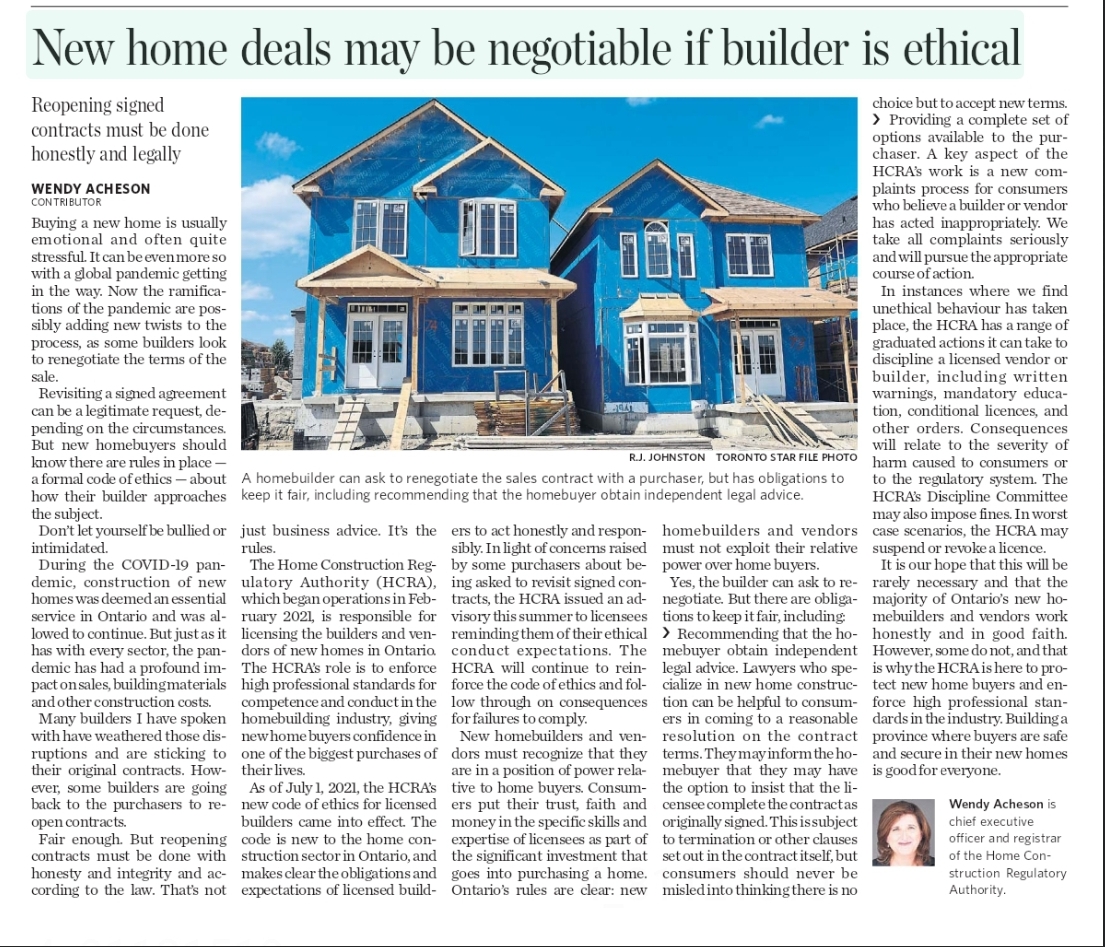
Many consumers were taken aback to read the article published Oct. 9, 2021 in The Toronto Star, (image below) written by your new CEO of the builder regulatory agency, the “Home Construction Regulatory Authority, (HCRA).
In this article, the new CEO and Registrar, Ms. Wendy Acheson, says builders can re-negotiate new home sales contracts they’ve already signed, due to the rising cost of building materials and “other construction costs”, as long as they’re “acting with integrity and honesty”.
THis is a surprising article from a regulatory body. it would seem more appropriate coming from a Builder lobby group. The regulator’s mission is to protect consumers, not the industry it’s regulating.
There are several serious problems with this article from the consumer point of view. I outline a few below.
New home buyers, just as builders, have suffered significant financial hardship during the pandemic. They have also experienced delay after delay in new home construction, while scrambling to find alternative accommodation or financing, as the delivery of the home is pushed further and further into the future. None of these hardships are taken into account in this article.
If builders can re-negotiate sales contracts, can purchasers also do so, if their costs have gone up as well?
But even if they could, few consumers have the extra funds or time to hire experienced lawyers.
The advice from the HCRA CEO is “don’t let yourself be bullied or intimidated“, and “never be misled into thinking there is no choice but to accept new terms”. This doesn’t reflect the real experiences of consumers in the current tight supply market especially when up against large corporations.
Builders must act “honestly and responsibly“, says the HCRA CEO. Have you ever met a builder who would say he doesn’t act honestly and responsibly?
HCRA has a new Code of Ethics we’re told. Most businesses do, but that doesn’t mean it’s enforced, or that anyone has the means to prove anyone else acted unfairly. Unless the purchaser can afford a top lawyer, and has hours of free time, it’s a costly, lengthy battle to try to prove this.
Nowhere in this article does the CEO say that HCRA is the regulator of builders, she only mentions the licensing function. In paragraph 7, she writes “HCRA is responsible for licensing the builders…” This may be a mistake, since it’s in the title of the organization, but for consumers it’s a concerning omission in this article. After the failure of the previous regulator Tarion, consumers need to see the new regulator is doing its job. They want to see clear standards, monitoring of compliance, and transparency in the results and builder track records. Giving permission to builders to renegotiate signed contracts should be at the bottom of the new regulator’s list, if at all.
New home builders already write their own water-tight contracts with the help of top lawyers, and can fend off consumer scrutiny they don’t want during the sales and construction process. Many contracts by major builders I’ve seen include “weasel clauses”, for example forbidding class actions, preventing critiques on social media, and forbidding complaints during construction, …or else the builder can terminate the contract.
Power imbalances in new home purchases are worsening. Where’s the consumer protection?
HCRA’s CEO admits “builders are in a position of power relative to home buyers”. But her advice – “don’t let yourself be bullied or intimidated” – is useless.
She must know builders write their own contracts and include all the extra clauses they like to protect their own interests. Anyone who objects will be shown the door.
Consumers have limited choices in homes they can afford, which might be close to their work or other family members. One buyer told me the advice he got from his own lawyer was to keep quiet about construction problems, or the builder could cancel the contract, since the terms allowed him to do so. For the industry regulator to tell consumers “don’t let yourself be bullied” seems out of touch with what’s really going on in this tight supply market. Some builders may be unfair, unethical, or even by-passing consumer protection laws, but to prove it you’ll need deep pockets for lawyers and months of free time for complex legal battles.
The worn-out advice given to consumers by the Ministry and the HCRA CEO is to “obtain independent legal advice”. This can only make sense coming from government and agencies like HCRA who have their own in-house counsel paid for by taxpayer or home purchaser, and don’t have to pay out of their own pocket.
Sure, lawyers can be “helpful“, as Ms. Acheson says. But these fees could eat up $20,000+ of one’s savings for a simple dispute when the opposing party is a large corporation. HCRA’s advice is blind to the consumer experience and the uphill battle for individuals fighting large builders.
“The HCRA is here to protect new home buyers”, says HCRA’s new CEO. But this article is promoting builders’ interests, not consumers’.
Contracts are supposed to balance the rights and responsibilities of both parties. But if terms are as movable as sand, what credibility do contracts have?
It’s concerning that HCRA in the first months of its operation is coming up with this idea on how builders can protect their profit margins, and promoting this in the pages of major media. If you order a new car to be delivered in six months, and the price of steel goes up, can the dealer renegotiate the price you both agreed to pay in the contract? Would a government agency advocate for this?
Why is HCRA publicizing this practice, which will only decrease home affordability?
This article exemplifies the larger problem: government agencies like HCRA tell us they’re protecting consumers, but show a lack of understanding of the consumer perspective.
A possible solution, which has been suggested to the Consumer Ministry several times, could be to create a Consumer Watchdog Office, to make sure consumer perspectives are understood in policy-making.
After 42 years of the failed regulator Tarion, consumers need to see if HCRA will protect new home buyers, not act as a lobby group for builders. The industry has several of thier own well-financed politically-connected lobby groups to do this.
HCRA still has not answered what is the status of the 95 complaints about licensed builders it received within the first two months of operation, or the Auditor General’s finding that 65% of the time between 2014-18 builders did not repair items they should have under the warranty. These are important questions for consumers who put their life savings into a new home and rely on a well-regulated industry.
We look forward to your response as Minister for consumer protection, part of a government which tells us it’s For The People. How does this article fit into HCRA’s mandate? How does the renegotiation of contracts help housing affordability? How does it create the “fair” marketplace which your ministry promises?
Tarion’s self report card gives them an “A”. But what’s actually been done in two years since the Auditor General’s report on this government agency responsible for protecting new home buyers and regulating builders?
Not much.
Here’s a fact-check.
Still no independent oversight; little action
Serious problems were brought to light after 43 years of Tarion operating in near secrecy: bias toward builders, lack of deterrents to bad building, and incentives for executives to deny claims, all this from a “consumer protection” agency of government.
Tarion says it has implemented 19 of the 25 recommendations directed to them. The Consumer Ministry has, predictably, rubber-stamped just about everything Tarion says. To try to silence decades of consumer and Opposition complaints about Tarion, they’ve called this “a complete overhaul”.
Like all self-congratulatory claims from government and its agencies, this needs a fact-check. With my 10 years experience observing Tarion and participating in legislative change, here’s mine below, looking at each of the Auditor’s recommendations one by one.
1)Auditor General’s Recommendation #1:
Tarion’s board was told it must balance the interests of homebuyers and builders, and that there should be no more financial sponsorship to the Ontario Home Builders Association (OHBA).
Not accomplished:
– Tarion’s board still has no consumer advocates, still two builders, and a total of four people with ties to the real estate industry. Tarion still co-sponsors a Builder Awards programme with the builder lobby group, OHBA. Where’s the advancement in consumer protection?
2) Recommendation #2:
Tarion must make sure home buyers understand the Home Buyer Information Package and the importance of the Pre-Delivery Inspection.
Not accomplished
– Pre-delivery “inspection” (PDI) is only a visual walk-through of the new home with a builder’s representative, whose vested interest is completing the sale, not identifying defects. The word inspection is misleading. – To be meaningful, this inspection should be done by a qualified independentinspector. Consumers should be allowed to video or voice record these walk-throughs (Tarion has always forbidden this), and in the PDI material it should be clear the homeowner can bring his own home inspector. – Tarion says a new “Warranty Information Sheet” will now be attached to all purchase agreements. No information on how/if this is being enforced.
3) Recommendations #3 and #4
The Auditor’s Report stated that information on warranty coverage and consumer’s rights should be less confusing. Tarion was to stop telling consumers it provides a warranty since it doesn’t. It’s role is to “hold builders accountable for addressing unresolved homeowner warranty claims to builders.”
No meaningful action
Tarion has finally removed the word “warranty” from its name, but not from executive titles such as “VP Warranty Services”. After 43 years, Tarion says it’s only a financial backstop to the warranty provided by the builder. There is still vagueness about Tarion’s responsibility to the consumer. Defects are to be reported to the builder and repaired by them. But the problem still remains: Tarion waits in the background as a “financial backstop” if builders refuse to fix defects. There are still too many extended repair times, while Tarion tries to coax the builder to do repairs. This is still a passive role, and there are too few deterrents to builders who don’t fulfill their obligations.
– Tarion has added a “Homeowner Learning Hub” to their website. This is addressing the wrong problem: the problem of bad building is not lack of consumer education.
4) Recommendation #8:
Tarion is to create a simpler, less costly, homeowner-friendly appeal process for consumers whose claims have been denied.
Marginal change
Tarion has made outside mediation available in some cases, on an ad hoc basis, but this week this has been put into regulations by the Ministry. There should be clear guidelines on when mediation can be used, it should be available to all, and the fact that it had to be used to resolve a dispute should be published on Tarion’s or HCRA’s website. Oversight of this process by the Consumer Ministry is needed, or by an independent administrator.
Consumers should be entitled to have a friend or representative of their choice present at mediation, Tarion cannot veto the consumer’s representative; all persons at mediation should be identified on screen in virtual sessions, and Tarion and builder representatives should be limited in number to avoid imbalances of power and perceptions of intimidation.
Tarion should pay the full cost of mediation, (not half as suggested), and this should be seen as part of the warranty fee, as in multi-provider warranty systems.
5) Recommendation # 10
Builders who do not honour their warranty obligations should be held accountable by Tarion, and their poor record taken into account in future licensing decisions.
No meaningful action
All Tarion seems to have done on this, according to their own “Implementation Plan” published in Fall 2020, is to say they will “review and up-date” evidence given to them by builders, “provide more guidance“, and “train staff“.
But the problem the Auditor General pointed out (pg. 30, of her 2019 report) remains. There are still too many “exemptions” builders can use to avoid inspections, and documented defects sometimes do not impact future licensing decisions. It is unknown how or if Tarion’s new companion organization, (Home Construction Licensing Authority, HCRA), will disclose these defects, or if they will suspend/revoke licenses when necessary. The pitfall again is lack of independent oversight of these agency’s activities.
There is still few meaningful consequences to builders who deliver shoddy work. This problem, and the same builder-friendly corporate culture, seems now spread across two agencies, both Tarion and HCRA, since HCRA has hired Tarion employees and adopted without sufficient scrutiny their builder track records.
6) Recommendation #11
Tarion is to consider all data about a builder’s past warranty performance when deciding whether to grant a future license.
No meaningful change
Tarion says it has now adopted “a more comprehensive approach” to assessing a builder’s record. But other than promising to “finalize an internal memo and policies“, (pg. 14, Tarion’s draft copy, on implementing Auditor’s report, Jan. 4, 2020 ), it’s not clear anything has changed, either at Tarion or the new HCRA.
The Auditor’s report stated Tarion continued to grant licenses to builders with shoddy records. This is a huge consumer protection failing, and has not been adequately addressed. A commitment to “consider” this information is not the same as fixing it.
Three steps forward, five steps back
7) Recommendation #12
The Auditor’s report stated Tarion should make sure builders have the financial stability to complete proposed projects, and honour their warranty obligations.
No meaningful change
Tarion says it developed “a new process to collect and review this evidence” on a builder’s financial history (see Tarion’s Implementation Plan, pg. 8). But what’s to stop builders from citing “privacy reasons” (as in the 2016 case of Urbancorp), to avoid disclosures, or giving vague reasons for cancelling projects, like not being able to get financing. There’s nothing here to show this consumer protection failing has been fixed.
8) Recommendation #13
Tarion is to protect consumers who purchase pre-construction homes if they are later cancelled or delayed by legal restrictions on land.
No meaningful change
Tarion says it has “conducted an analysis” on what construction projects require a review of the land title. It’s concerning this wasn’t being done before. Why is a builder with dubious legal right to build on a site taking deposit money from consumers? “Publicly disclosing” restrictions, as Tarion says it will now do, seems too little too late.
Why does a project get a building permit in the first place, if the builder has a dubious legal title to build on the land? What’s to stop builders from refusing or delaying to provide information? This is Tarion’s answer: “Tarion has determined the best approach for obtaining information in title searches and has made this a requirement“. What’s the “best approach“, and what are the penalties, if any, for not fully providing this information? No teeth, no effective policy.
9) Recommendation #15
Tarion should ensure homeowner complaints against builders are properly investigated.
No meaningful change
“Adding resources” and “eliminating the backlog of complaints” is what Tarion says it has done. That’s not enough to make a difference. The problem remains: lack of independent inspections during construction (it’s not enough to rely on municipal inspections), and lack of enforcement and disclosure of bad conduct or lack of integrity.
Setting up a builder Code of Conduct and establishing clear consequences for those who breach it has been shifted to the new agency, HCRA. There will be no clearly defined Code of Conduct till July 2021. Tarion has never had one, which has enabled many builders to escape meaningful scrutiny and consequences.
What of the problems cited in the past of hiring unskilled trades, no supervision of trades during construction? If Tarion rarely inspects on-site, the onus is on the homeowner after the home is built to be the whistleblower, which often creates animosity and may adversely affect repair work. Without a clear Code of Conduct, enforcement, and deterrents, this problem is much the same as before. No teeth in enforcement, no transparency, no credible independent oversight.
10) Recommendation #16
Tarion was asked to strengthen the builder licensing process, minimize warranty issues related to the Ontario Building Code, and inspect homes for compliance with the Code during construction.
Marginal Change
Tarion says it has “conducted a pilot programme” for inspecting the work of “relevant builders”, and implemented a “permanent risk-based inspection process.”
This seems to indicate risky builders’ work may be checked, that Tarion knows who they are, but there seems no disclosure to the public. Where’s the list of “relevant builders“, as described above? Why are their licenses not suspended or revoked; where’s the transparency about their risk profile?
11) Recommendation #19
Tarion is to hold builders accountable for the cost of warranty obligations Tarion has to pay on their behalf. The results of this are to be made public.
Marginal Change
Tarion says it has “implemented a new collections strategy”, without specifying what it is. They say they will “publicly report collection efforts” each year. Will Tarion report this to their companion organization, HCRA, who decides licensing matters?
Builders can still cite “privacy concerns“, and there may still be exceptions and excuses for not paying back the cost of warranty obligations. This is important information for consumers to see on a builder’s record. Making this public, despite builders objections, may be a small incentive for them to pay up.
12) Recommendation # 20
Tarion is to disclose more information on builder track records to help home buyers make informed choices. For example, major structural defects, lack of integrity, not paying back money owed to Tarion, warranty work builders refused to repair, etc.
No Meaningful Change
This responsibility has been shifted to HCRA, which has simply published Tarion’s builder records, with the same content, without apparently fact-checking it.
Tarion says it “sought public input” on what should be added, and “up-dated the Ontario Builder Directory with this information“. This says nothing, and there’s no evidence any records have up-dated or corrected, other than a few cosmetic changes made to the website.
The practice of giving “customer services gestures” to homeowners to settle disputes enables Tarion/HCRA to avoid listing these payments on the builder’s record, as a way to pay to make problems go away and leave the builder a clean record. This should also be disclosed for what it is, a cash payment to settle a dispute regarding defects.
The same for “non-disclosure agreements” or NDA’s: they should be forbidden, since they don’t help consumers, they help hide a builder’s poor record. Most reputable builders will repair defects immediately and never let problems get adversarial or litigious. The public has a right to have access to complete builder track records in order to make informed decisions.
13) Recommendation # 23
The Auditor’s report found that Tarion should investigate illegal building (i.e. builders who build without registering the new homes under the warranty), in a timely way.
No Meaningful Change
This task has been shifted over to HCRA. Tarion says it has “added the necessary resources to eliminate the backlog of investigations”. A back-log of investigations indicates homes are being built and sold without the warranty coverage. This problem has been known to Tarion for over a decade, with minimal real action to stop it. There are too many exceptions builders can use to avoid enrolling homes under the warranty.
ALL new homes should be under the warranty, no loopholes, no exceptions.
14) Recommendation #27
Tarion is to require their staff who are sent on-site to inspect Building Codeviolations to have the Building Code certification.
No Meaningful Change
One of the on-going criticisms of Tarion for years is that they send personnel to inspect defects who have no training in the area of the defect. Tarion says it has implemented a “training programme“, and future warranty assessments “will be reviewed by staff with relevant training“.
ALL Tarion staff sent to inspect homes should have at least minimum Building Code certification, the bare minimum standard. Staff sent to inspect should have expertise in the area of the problem being reported, for example HVAC. This should be obvious, but has not been done, enabling Tarion to say defects are not warranted.
Tarion staff attending inspections have told consumers they “don’t have any construction knowledge“, and have forbidden consumers from recording or video-ing the inspection. This raises mistrust, and should never be forbidden, under the threat of Tarion walking away from the inspection. More training is a long-term goal, and doesn’t fix the problem of ingrained bias toward builders, or fear of offending the the powerful players, which is still part of the Tarion culture. This is perpetuating an organizational culture problem, not fixing it.
15) Recommendation #28
The Auditor’s report advised Tarion to provide homeowners with accurate information in a timely manner through its call center staff.
No Meaningful Change
Tarion says it has hired more staff, trained them properly, and is reviewing phone calls “for quality assurance“.
This may be a goal, but is not a statement of anything achieved. What are the “clear service standards” Tarion says it has implemented? Without independent monitoring outside Tarion, this is of little value.
Examples of inaccurate information given by Tarion office staff are: the LAT is less formal and more consumer-friendly than courts, without saying consumers lose over 83% of these cases; the internal Ombudsperson handles fairness issues, without advising that this office is not independent of Tarion. There is no assurance the information given is consumer-focused, and not biased toward Tarion’s or builder’s interests.
This is one of the reasons the Opposition parties called in 2020-21 for an independent administrator to oversee Tarion, to make sure problems of past decades are not repeated. This is sill a good idea, not the self-monitoring and self-reporting Tarion still does with most of the same employees and senior executives as before.
16) Recommendation #29
The Auditor’s report expressed concern over the lack of independence of the internal Tarion ombudsperson. The report stated this office should report to and be evaluated by Tarion’s board.
No Meaningful Change
Tarion says the internal ombudsperson now reports to the board, and her “self-review” will be reviewed by the board. This does not make the ombudsperson independent of Tarion, or gain consumer trust. How would the board evaluate the ombudsperson’s self-review, since complaints given by consumers to her are confidential?
This office has no mandate to get involved in warranty disputes either, so what’s its point of it at all? Consumers have, for over a decade, said this office is a waste of their time, and has in the past shared confidential consumer information with Tarion’s internal legal department (see Auditor’s report, 2019, pg. 48).
If it is to have any credibility or value at all to consumers, and that’s still a big if, this office should help resolve warranty disputes, and report independently to the Ministry, not to Tarion.
17) Recommendation # 30
Tarion is to review its compensation to be more in line with the intent of legislation it administers. Bonus pay methods must be consistent with public-sector practices.
No Meaningful Change
Tarion has now been forced by the Ministry to disclose executive pay, which has been kept secret for 43 years. This disclosure shows compensation for the retiring CEO of $1.9 million in 2020, with the current CEO still earning $552,000, and seven Vice Presidents, two earning over $400,000. This is still the current pay level, in spite of half of Tarion’s responsibilities having been moved over to the new regulator, HCRA. Tarion paid salaries and benefits of $30 million in 2019, while the total claims paid out were only $13 million. (2019 Annual Report, pg. 8).
These are alarming financials for a government agency, a not-for-profit monopoly.
There’s no indication that bonuses are no longer linked to dismissing claims, which was a concern raised in the Auditor’s report. Tarion says it has published “key performance indicators’‘, “adjusted bonus pay“, and “hired a third party expert” to review comparable organizations. This expert concluded that all was good with this pay scheme, comparing Tarion’s pay to that of Walmart, while Tarion has 200 employees, and Walmart over 90,000.
This financial picture cries out for further scrutiny.
18) Recommendation #31
Tarion must confirm the sufficiency of assets in the Guarantee Fund to cover any future catastrophic defects.
No Meaningful Change
Tarion says it has hired “independent experts” to review its Guarantee Fund annually. With over $500 million in the Fund, and claims pay-outs in the range of $10 to $13 million, this is of little help to consumers who’ve had their claims denied.
The focus should be on preventing bad building up-front, properly regulating and licensing builders, thus avoiding most catastrophic building deficiencies and pressure on the Guarantee Fund. A multi-provider warranty system would have put the risk assessment on individual insurers, not one warranty fund. But his government decided against opening up this field to competition, without following the advice of the 2017 independent Tarion review.
——————————-
These following 6 items have been defined by Tarion as not complete, two years after the Auditor’s report:
19) Recommendation #5
Tarion is to ensure consumers who move into new homes which are partially complete have full warranty coverage, even for unfinished items.
Not Accomplished
A new definition of “finished house” is to yet to be released; no new warranty has yet been decided upon to protect homeowners for unfinished items.
20) Recommendation #7
Tarion is to make sure homeowner disputes with builders are resolved in a timely manner.
Not Accomplished
Tarion says it has begun an analysis of these timelines and has “implemented a process to notify all parties if they are unable to meet their own timelines for decisions”. They promise to “conduct training for staff” and “conduct compliance audits” of the new processes.
This shows little hope of change from the current system. Warranty decisions can be drawn out, builders given too much time to delay fixing problems, and then more extensions. Tarion seems still overly concerned with keeping builders happy. All this time during disputes the consumer has to take hours or days off work for multiple visits from Tarion and builder staff, with no resolution to their under-heated home or leaking basement.
If the builder doesn’t repair within a specific time frame laid out in the warranty, Tarion should provide another qualified independent trade to do the work at the cost of the warranty.
Any audits of this process should be done by an independent compliance officer, not by Tarion itself. Cash settlements and “customer service gestures” are often not helpful, since the consumer has to research and hire trades, supervise the work, which could void the home warranty in some cases. Remedial work should be Tarion’s responsibility, through its engineering and trades network, many of whom testify for Tarion at LAT appeals.
21) Recommendation #24
Tarion has not followed many recommendations of its own internal ombudsperson since 2008. There have been 38 in total since 2018, Tarion says it has completed 25 of these, and 13 remain unaddressed.
Not accomplished
Tarion says it has addressed “all but one” of these items, and will report on its progress on its website.
The fact that 30 recommendations on “fairness” issues have been made by the internal ombudsperson since 2008, and Tarion has not implemented ALL of them, indicates they themselves don’t take this internal office seriously.
The ombudsperson’s office fulfills no useful purpose for consumers. If Tarion is not even meeting its own internal monitor of “fairness”, that’s a failure of oversight by the ministry. Posting publicly the ombudsperson’s reports on fairness won’t fix a leaking roof or mould in new homes.
This office should be dismantled, and the money used to solve warranty disputes and fix homes.
22) Recommendation #6
Tarion is to make it easier for homeowners to seek its help.
No Progress
Tarion says it is “taking public feedback” on this, and has proposed extending some reporting deadlines by 10 days, enabling consumers to add items to lists, and expanding the definition of emergency claims to include water penetration.
This seems like a stalling tactic, and more window-dressing. Two years after the auditor’s recommendations, Tarion is still seeking public input. Why hasn’t the extra grace period of 10 days ever been done before in its 43-year history?
This is another indication a builder-friendly, insular culture, not a transparent, consumer protection, pro-active one. A 10-day grace period seems a meager gesture.
23) Recommendation #17
Tarion is to report to municipalities builder instances of non-compliance with the Building Code.
No Change
Why is Tarion not reporting violations of the Building Code to municipal authorities who grant building permits? Tarion’s concern is that “the sharing of this information raises privacy considerations”. That indicates protecting the builder’s privacy takes precedence over protecting new home buyers.
“Seeking public input” and “establishing working groups” is a timid plan, Tarion looks torn again between builder protection and consumer protection.
24) Recommendation #32
Tarion is to schedule annual public meetings where consumers can physically attend to ask questions and voice concerns.
No Change
Tarion says it will reinstate in-person annual meetings as in 2009-15, after the current pandemic restrictions of 2020 and 2021 are lifted. Tarion cancelled its in-person meetings after homeowners angrily voiced concerns at the 2015 annual meeting.
Tarion forbids consumers from recording the meetings, and cuts off the microphone when questions become highly critical. They post a redacted, softened version of questions on their website, which has been criticized by consumers, advocates, and media reports since 2011.
Webcasts where Tarion makes speeches and cherry-picks questions by email from anonymous virtual attendees are largely useless. For transparency and accountability, consumers should be allowed to record in-person meetings, the “consumer appointees” to the board should be present to answer questions, as well as at least one senior Ministry official. All questions should be posted verbatim on the website and answered. ————————–
As I finish this analysis, I’m left with the starting point of my work 10 years ago: lack of transparency and accountability of this government agency, lack of independent checks and balances and oversight, a builder-friendly monopoly with the same corporate culture as the last 4 decades, writing its own report card, nodding publicly to the Auditor’s directives, but leaving us with the same monopoly, which has now spawned a second one, HCRA.
Tarion cannot be left to fix itself and write its own report card. It may have changed its coat, not its colors.
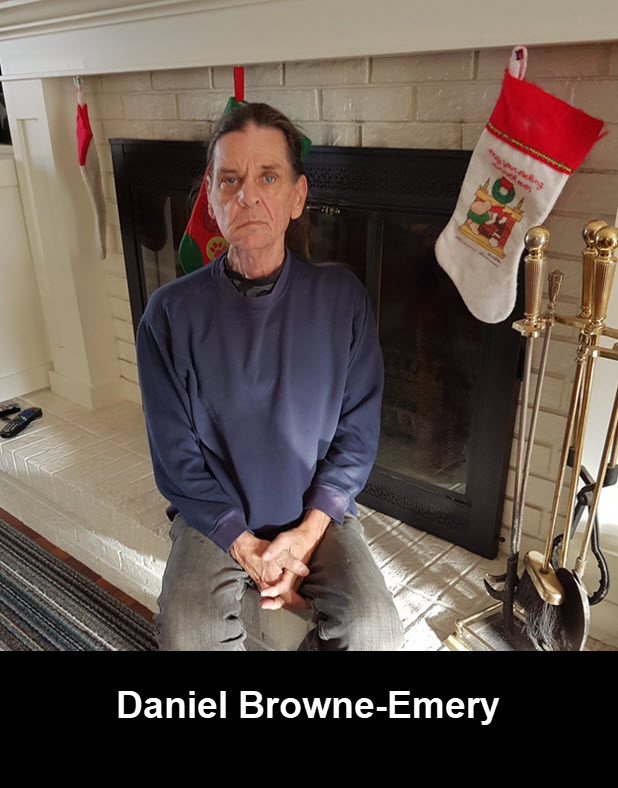
Daniel Emery’s heartbreaking story: from home-believer to home-wrecked, to advocate for change
Photos of Daniel, from 2015 and 2019
I hope one day, after almost 10 years of writing about the broken Tarion warranty legislation in Ontario, I’ll be able to write a story on how Tarion has protected consumers in crisis, instead of abandoning or over lawyer-ing them to death.
This is not that day.
Last weekend, homeowner Daniel Browne-Emery passed away after a long battle with a cruel and relentless cancer, and the government agency Tarion, which seemed to him just as cruel and relentless.
This is my personal thank you to Daniel and his family for their years of efforts to make Tarion the consumer protection agency the legislature once intended it to be.
Like the rest of us advocates, Daniel wanted the government to follow justice Cunningham’s #1 recommendation in his 2017 review to open the warranty field to competition, and end Tarion’s government-granted monopoly and bias toward builders.
Like most advocates who work toward this goal, many have been victims of Tarion themselves, and have advocated at the Ontario legislature for years for changes to the laws governing Tarion. Daniel was one of us.
Here are some of my memories of this honest, strong, courageous consumer advocate.
I didn’t know Daniel well, but within a few moments of hearing his nightmare story in 2013, anyone could empathize. How is it even possible this could happen in Ontario, a modern democracy with a government agency regulating builders and protecting consumers? Each time I tell his story, it’s met with incredulity and anger. The story continues to haunt us, and should haunt our legislators. But other than the usual platitudes about protecting consumers, they seem focused on keeping the building industry happy.
Tarion is a political problem. It was created by politicians, and only they can solve it.
And they have not.
I first met Daniel at the office of an Opposition MPP at the Ontario Legislature in 2013. We were there to support a bill brought by the NDP to fix broken Tarion. That, and many other meaningful bills were never passed by either the Liberal or the PC Parties, both well-known to have close relationships with builders and developers, while telling us they’re champions of the little guy.
What happened to Daniel, and sadly continues to happen to new home buyers in Ontario, should never should have happened, and could have been avoided.
In short, here’s Daniel’s troubling story, which I wrote about on this blog site http://www.consumersreformtarion.com in 2018. I hoped after that the Consumer Ministry would take action, but nothing happened.
Daniel moved into a newly-constructed home in 2007. A few weeks later, he discovered water on the basement floor, which led to flooding. He contacted Tarion, and the builder; Tarion requested the builder take action, but little was done. Months and years passed with Daniel pleading with Tarion to help him. Mold began to take hold, with black slick and patches “as big as pizzas” in Daniel’s words. Tarion finally did some visual mold remediation, but didn’t fix the underlying cause of the water infiltration. By 2008, Daniel said there were four feet of standing water in his basement, and slimy black mold on the staircase carpet and walls.
In 2011, his bank refused to renew his mortgage, because he couldn’t get insurance for the home under these conditions. The bank then foreclosed, and Daniel was left homeless, and lost over $270,000 he’d invested in the home.
Financially devastated, he then was hit with bad health news, a diagnosis of throat cancer. His oncologist asked if he’d ever been exposed to mold. “My heart sank when I heard this”, Daniel explained.
When I spoke to him in the summer of 2018, he could barely talk due to the ravages of cancer and the on-going treatments. He was at work, driving a heavy truck, on one of the routes he liked to drive from Toronto to Quebec City. He stopped to have a coffee at a roadside shop and half-joked to me that he seemed to scare people away now, they looked askance at him with his weight loss, long hair, and misshapen smile.
He said when he read my blog post, it made him break down. He was grateful I’d sent it to the Minister and various journalists to try to get someone to do something about the nightmare he’d suffered.
When a consumer threatens to go public, Tarion often swoops in to stop the wheels turning, secret meetings are held, consumers are sworn to confidentiality, and many who are in dire financial straits have no choice but to sign a non-disclosure agreement (NDA).
There’s been no meaningful action from our government, except window-dressing weak bills, and posturing about how Tarion protects consumers.
Daniel’s local MPP had written a letter on his behalf on Sept. 27, 2013, to the then Liberal Minister, stating: “He lost his home due to the actions, or more specifically the lack of action from Tarion. Mr. Emery was forced to foreclose on the home and lost everything waiting for Tarion to take action again the builder.”
Exactly.
Now this long-time PC MPP is part of the current PC government, but he’s gone silent. In the meantime, the builder has gone on building more homes, with nothing mentioned on his Tarion record, and no way for future home buyers to be forewarned.
In the fall of 2019, Daniel felt the cancer again pressing at his heels. He wanted to make sure, if he couldn’t do anything in his own case, that others wouldn’t be devastated like him. He offered to drive to Toronto and tried to arrange meetings with journalists, even though he was weak and could barely speak.
I asked if there was one point which encapsulated his ordeal, one dark moment when he was about to give up. He thought for a split second, and said, yes. Every Saturday, he said to me, he’d spend scraping black, slimy mold from the basement staircase and walls, with his dog often beside him. In a moment of desperation, he turned to his dog and said, “I think this house is going to kill me”.
Tarion refused to give Daniel certain reports, like the mold report they had commissioned, and which was requested by his oncologist. Tarion told him repeatedly his case was closed, because he no longer owned the house. They also refused to issue him a “Decision Letter” which would have allowed him to have his claim heard at the License Appeal Tribunal.
If two major corporations want to battle it out for years on a legal matter, fine, they’re equal adversaries, and fighting on a level playing field, with comparable finances and resources. But most new home buyers are on their own, self-represented, and can’t afford $400-$1,000 per hour for experienced lawyers, and even more for engineering reports. This is not the time for a consumer protection agency to bring out the heavy legal artillery, hard-hitting emails, and heavy-handed tactics. But that’s what Tarion did in Daniel’s case. And too many others I’ve seen.
This tragedy should have been prevented. If the root cause of water infiltration isn’t addressed, it will recurand get worse. Tarion failed to get to the root of the problem and fix it. Treating symptoms doesn’t work long term. The builder and Tarion ended up blaming the homeowner, as happens too often, and they let time slip away until Daniel was too ill and financially devastated to keep fighting for justice.
One of the serious problems with Tarion is it says it can’t force the builder to do anything, the warranty is the builder’s, and Tarion is only there to ‘back-stop” it, and make sure they fulfill their obligations. But often they don’t even do that. The Auditor General’s report (Oct. 2019) found that in 64% of cases from 2014-18, Tarion did not get builders to fix warranted defects.
Why is this still going on?
Too much influence from builders, too much concern about protecting the builder’s “privacy”, no teeth to enforce the Building Code, buck-passing from municipalities to builders to Tarion, too lax oversight by government. Still a deeply flawed system.
But builder lobbyists like it, say it’s “working well”. However, the legislation wasn’t created to protect builders, but to protect new home buyers.
Daniel and his wife finally got a meeting with Tarion’s CEO in early 2020, thanks to the continued advocacy of a not-for-profit consumer organization. The current Tarion CEO is a former in-house lawyer, as are many of his VP colleagues. All are well-versed in legal tactics to protect Tarion and builders, and get claims dismissed.
This last contact Daniel had with Tarion top executives at their head office, was physically and emotionally painful, he told me. He was asked to sign a non-disclosure agreement. A dying man? What’s the objective of that, where’s the decency?
He told me a few details of the meeting. One made him smile, he said, telling me he knew it sounded childish, but as he was leaving, he asked the CEO if he knew where he could get one of the glass coffee mugs with the Tarion logo they had in their offices. The CEO said he wasn’t sure. His colleague lawyer then disappeared into the kitchen and came back with a mug.
After 13 years of battling Tarion, maybe this was for Daniel a spoil of war, something physical taken from the enemy to prove you’ve survived.
Refusing to give this dying man a mold report so he could give it to his oncologist, is an unnecessary bully tactic; making a dying man sign a non-disclosure agreement for a meager settlement while he’s lost his life savings through the actions of a shoddy builder, while he relied on this government agency to protect him, is unforgivable. Not listing these defects on the builder’s record is adding insult to injury, and worse, complicit with shoddy builders, and a disservice to future new home buyers.
I know Daniel would have liked to hear that his work in the end counts, and won’t be forgotten. The house may have killed him, but Tarion and our lawmakers look like willing accomplices.










 CONSUMERS' REFORM TARION